Safety Alert: If you are in danger, use a safe or private computer that an abuser does not have direct or remote access to. Learn more about technology safety at techsafety.org. NDDSVC does not provide direct services to victims and survivors. Contact a DV/SA advocacy center near you to get help. If you are in immediate danger, call 911.
Domestic violence is no “little fight” between a husband and wife. It’s a serious, often life-threatening pattern of abuse that puts the health and safety of men, women, and children at risk. Abusers use physical violence, sexual violence, intimidation, threats, and psychological manipulation to gain complete power and control over their victims, leaving many survivors living in constant fear. Fear for their safety. Fear for their children’s safety. Fear of not surviving the violence. Fear of what comes next if they do.
“As a state and a nation, we must recognize domestic violence for what it is: a deadly crime,” said Seth O’Neill, Executive Director of the North Dakota Domestic & Sexual Violence Coalition. “Domestic violence is not a private matter that happens inside the home. It affects all of us.”
Everyone knows someone who has experienced domestic violence, whether we’re aware of it or not. And while we can’t end violence overnight, we encourage every single North Dakotan to be the listening ear, the supportive friend, or the neighbor that helps a survivor in a time of need. Your simple acts can make a difference.
“Confront domestic violence for what it truly is: a national crisis, never trivial, never private, and never to be ignored. That means shaping public understanding to reflect the seriousness of the issue, fully funding lifesaving services in every community, investing in prevention to stop abuse before it begins, and strengthening our systems so no survivor is left without safety, dignity, or support. Anything less is a collective failure — of our nation and of us as people.”
By simply recognizing how dangerous domestic violence is, we can help survivors get one step closer to safety.
So no, this is not a “little fight.” But we will keep fighting, together, because we believe in a world without domestic violence.
With hope for the future, NDDSVC
If you or someone you know has experienced domestic or sexual violence, free and confidential support is available 24/7. Go to our Find Help pageto view a directory of domestic and sexual violence victim advocacy centers and find support near you.
NDDSVC releases 2024 fact sheets on domestic and sexual violence
BISMARCK, N.D. — Each year, the North Dakota Domestic & Sexual Violence Coalition (NDDSVC) compiles data from domestic violence and sexual assault victim advocacy centers across the state to put together annual fact sheets. The fact sheets give a snapshot of how many victims of domestic violence and sexual assault are reaching out for help and what kinds of violence they are facing.
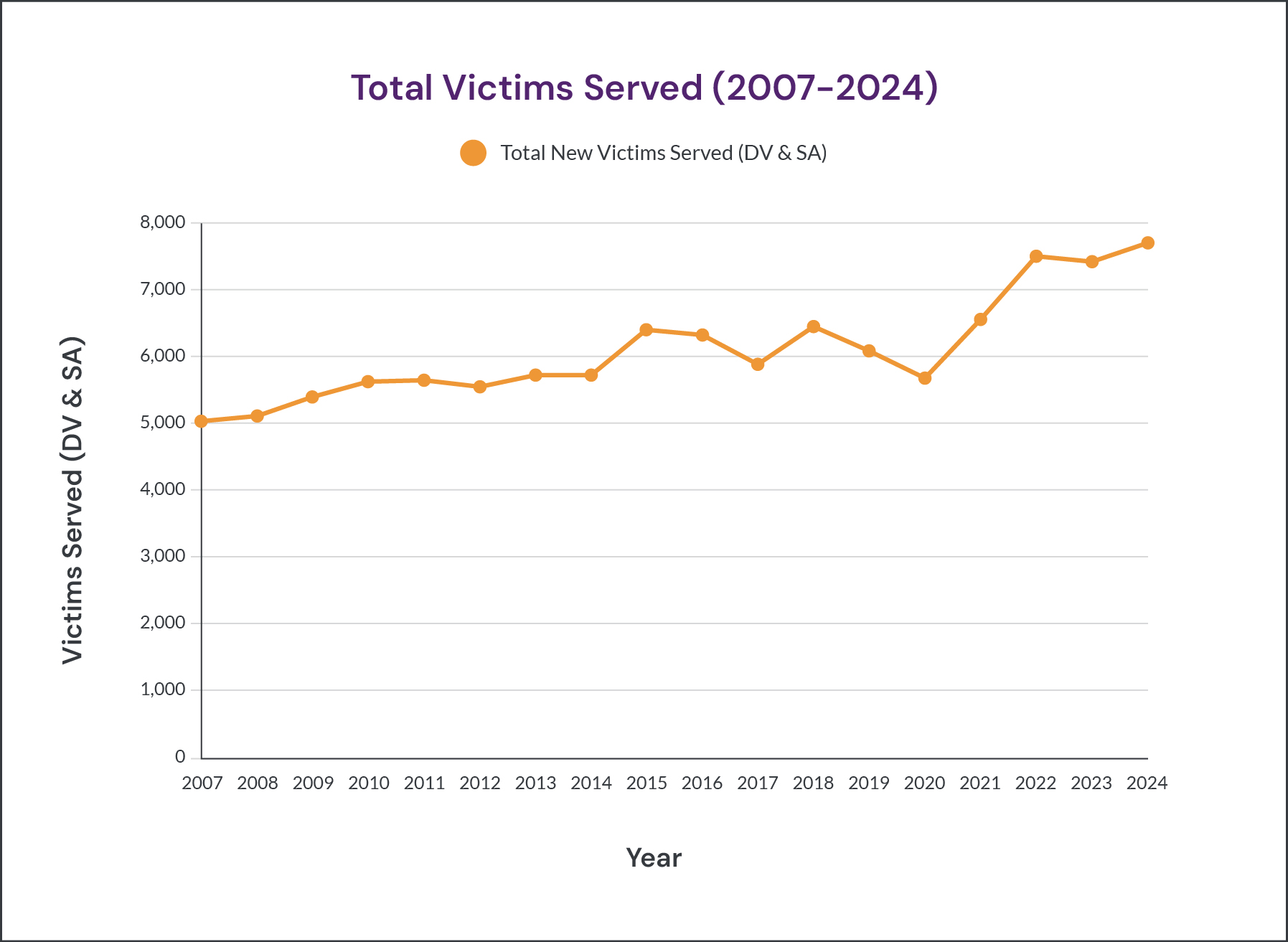
The latest fact sheets show that 6,334 victims of domestic violence and 1,363 victims of sexual assault were served by advocacy centers in 2024, a 3.3% and 5.8% increase from 2023 respectively.
NDDSVC says that domestic violence can happen to anyone, but women and children are most commonly victimized. Of the domestic violence victims served in 2024, 81% were women. At least 150 women were pregnant at the time they were assaulted, and 4,708 children were directly impacted by domestic violence incidents.
Women and children are also most commonly victimized in sexual assault cases. At least 1,101 of the 1,363 sexual assault victims served in 2024 were women, and at least 226 primary victims were under the age of 18 at the time of the assault(s).
People with disabilities in North Dakota were also highly impacted. In 2024, 23% of new domestic violence victims served were people with disabilities. Of the sexual assault victims served, more than one third (36%) were people with disabilities.
While their annual data gives insight into how many people are reaching out for help, NDDSVC says that it doesn’t represent the full scope of how many North Dakotans are experiencing domestic and sexual violence. The number of victims served in 2024 is only a fraction of the people experiencing violence they say, as many cases go unreported, not every victim reaches out for support, and some victims may get help from sources outside of NDDSVC’s 18 member organizations. The coalition says that funding to continue services is essential to reaching more victims and survivors.
“As the need for advocacy services grows year after year, funding has never been more important,” said Seth O’Neill, NDDSVC’s Executive Director. “These statistics only scratch the surface of how many North Dakotans are experiencing violence, and we must continue outreach, crisis intervention, and violence prevention work in order to end domestic and sexual violence for good.”
NDDSVC says advocacy centers work tirelessly to provide essential, life-saving services every single day. According to the 2024 fact sheets, 20,231 services were provided by advocates to victims of sexual assault from January to December. Domestic violence advocates provided victim assistance with 481 emergency protection orders.
The North Dakota Domestic & Sexual Violence Coalition (NDDSVC) supports and serves as a unified voice for 18 domestic violence/sexual assault (DV/SA) victim advocacy centers across North Dakota. From training and educational materials to public awareness and legislative policy change, NDDSVC works to provide North Dakota communities with the best tools and information to better support victims and survivors of domestic and sexual violence.
In just one day…
On September 4, 2024, 18 domestic violence programs across North Dakota served 304 adult victims of domestic violence and their children, answered 81 hotline contacts, and provided 6 educational sessions to 152 people. Yet, alarmingly, 52 requests for help went unmet due to a lack of resources, according to the 19th Annual Domestic Violence Count Report, highlighting the importance of funding to provide services.
Conducted annually by the National Network to End Domestic Violence (NNEDV) since 2006, the Domestic Violence Counts Survey is a one-day, unduplicated count of adults and children seeking domestic violence services in the United States. Each year, the Domestic Violence Counts Report summarizes this data and shares stories of both hope and heartbreak—from advocates connecting survivors and their children with lifesaving assistance, to programs being forced to turn away victims who urgently need help.
This year, the North Dakota Domestic & Sexual Violence Coalition (NDDSVC) joined the National Network to End Domestic Violence (NNEDV) in launching the 19th Annual Domestic Violence Counts Report. For nineteen years, Domestic Violence Counts has been the premier trusted source of data on the services domestic violence advocates provide to survivors every day.
“It’s easy to think that domestic violence doesn’t happen often or isn’t a huge problem in our state, but the Domestic Violence Counts Report shows how common domestic violence truly is. In just a single day, North Dakota advocates served 304 adults and children experiencing domestic violence. Federal and state funding are essential to providing these lifesaving services and keeping individuals safe,” said Seth O’Neill, NDDSVC’s Executive Director.
Tragically, on that same day, victims made 52 requests for services that programs could not provide because they lacked sufficient resources, funding, and/or staffing. Programs in North Dakota and nationwide need increased funding to support all survivors seeking help while also working to prevent violence in our communities. The lack of adequate resources has devastating consequences for victims and survivors. Without support from domestic violence programs, many survivors are unable to leave abusive situations or heal from abuse, and they may be forced to endure more violence.
Funding for Violence Against Women Act (VAWA), Family Violence Prevention and Services Act (FVPSA), and Victims of Crime Act (VOCA) grants are essential for programs, advocates, and survivors. Furthermore, additional resources must be provided, system-wide responses must be improved, and barriers to safety and justice must be eliminated to ensure that survivors are not left without resources and that no program is ever forced to turn away survivors or close their doors when faced with a decrease in funding.
The North Dakota Domestic & Sexual Violence Coalition (NDDSVC) supports and serves as a unified voice for 19 domestic violence/sexual assault (DV/SA) victim advocacy centers across North Dakota. From training and educational materials to public awareness and legislative policy change, NDDSVC works to provide North Dakota communities with the best tools and information to better support victims and survivors of domestic and sexual violence.
We see you, we support you, and you are not alone
To victims and survivors across North Dakota,
As the news reveals more about Ray Holmberg’s decades-long abuse and exploitation of men and boys, we—the undersigned advocacy and service organizations for survivors of sexual and domestic violence, child abuse, neglect, and human trafficking—want to speak directly to you.
We know this is a difficult time. The graphic details emerging through the news cycle, social media, and local discussions have created a wave of renewed pain and trauma for many. If you are feeling triggered, anxious, angry, heartbroken—or simply numb—you are not alone. These are normal reactions to traumatic events, and you do not need to walk through this alone.
For many survivors, hearing stories about violence and abuse can reopen old wounds or create new ones. It can feel as if your own experience is being dragged back into the light, without your consent. We want you to know: Your reaction is valid. Your experience is valid. Your pain is real. And your story matters.
You are not responsible for what happened to you. You are not defined by the choices of the person who hurt you. What someone did to you does not diminish your worth. You deserve safety, dignity, and love in every relationship you have—always.
If the headlines have felt like too much, it’s okay to step away. Turn off the news, unfollow triggering content, and log off social media if you need to. Taking a break is not avoidance; it is an act of self-preservation. Protecting your mental and emotional health is a powerful and necessary form of self-care.
Speaking of care—know that help is available across our state. There are advocates, counselors, and therapists trained in trauma-informed care who are ready to listen without judgment and support your healing journey. Whether what happened to you occurred last week or decades ago, whether you’ve told your story before or never shared it with anyone—you matter. And we are here for you.
If you’re not ready to reach out to a professional, consider talking with someone you trust. Conversations with supportive people—friends, family, community members—can be a great way to de-stress and work through what you’re feeling. And if someone you speak to isn’t able to offer you the care or understanding you need, it’s OK to set boundaries. You deserve to feel safe and supported in your relationships.
Finally, we want you to know you are not forgotten. Our organizations exist because we believe in a better world for you. We fight every day to end the cycles of violence and exploitation that have caused so much harm. We advocate for justice, for change, and for compassion—not just in times of crisis, but every day. And we will keep showing up, because your life and your healing are worth fighting for.
Generative AI has accelerated the creation of sexually explicit deepfakes. What can be done?
While manipulating intimate images and videos is not new tactic used by sexual violence perpetrators, the recent expansion of generative artificial intelligence (AI) for consumer use has accelerated the creation of nonconsensual manipulated intimate materials, or sexually explicit “deepfakes.”
Deepfakes include imagery, video, or audio that is produced or distributed without the consent of the subject and has been altered, potentially with artificial intelligence, to make it appear that a person is nude, partially nude, or engaged in sexual conduct. To be clear, there are also deepfakes that are not sexually explicit, like the ones depicting politicians. However, when we say “deepfakes,” we’re referring to sexually explicit deepfakes.
In the past, celebrities and public figures were the most common targets for deepfakes. Perpetrators once needed hundreds of photos to create a deepfake. Now, with generative AI, a deepfake can be created with just a single photo, making anyone a potential victim.
Victims of deepfakes often experience severe emotional distress and financial or reputational burdens. Victims may be threatened with physical or sexual violence. They may lose their job. They may pay thousands for an attorney, mental health support, or to websites that monitor the internet for deepfakes to remove them. Some victims have died by suicide.
If you’ve been a victim of a deepfake, know that it was not your fault. This is something that’s done to you, not something that you caused. We all have a right to access our phones, social media accounts, or dating apps without experiencing sexual violence.
Technology and AI themselves are not the problem though. Bad actors misusing them to abuse, threaten, and exploit others are. The good news is that there are steps we can take to prevent the creation and distribution of sexually explicit deepfakes.
AI platforms need to have rules and guidelines in place to prevent the creation of deepfakes. Social media platforms need to have an easy way to report abuse, and they need to dedicate resources to removing sexual content. We know that platforms have a streamlined process for quickly reviewing and removing content for copyright purposes. They need to show the same dedication to removing nonconsensual intimate images.
In North Dakota, lawmakers are actively working to prevent the creation and distribution of sexually explicit deepfakes. Sharing intimate images without or against consent is already against the law in North Dakota, and House Bill 1351 would make it a class A misdemeanor to produce, distribute, or transmit sexually explicit deepfake images or videos.
As individuals, we need to report deepfakes or other nonconsensual intimate material when we see it. We need to talk to our loved ones about online sexual violence and what warning signs to look out for so that we can report perpetrators before further abuse happens. Anyone can be a victim of a deepfake, but teens and young people are particularly vulnerable. If you’re a parent, talk to your kids about deepfakes and why creating and sharing them is harmful. Teach technology safety and make sure your children know that they can come to you for help if something happens to them. April is Sexual Assault Awareness Month, so there is no time like the present to start these conversations.
Finally, as North Dakotans, we need to examine how we think about and treat people online. We have a culture of “North Dakota nice,” but does that culture remain behind closed doors? The ultimate solution to ending the creation and distribution of deepfakes starts with asking ourselves, “Why are these images and videos being created in the first place?” Many perpetrators of deepfakes seek financial gain or power and control over the victim. But once we see our friends, neighbors, and even strangers on the internet as equal, respectable people and not as sexual objects to be consumed, degraded, and profited off of, we will address the root cause of deepfakes and sexual violence as a whole.
If you or someone you know has experienced domestic or sexual violence, free and confidential support is available 24/7. Go to our Find Help page to view a directory of domestic and sexual violence victim advocacy centers and find support near you.
NDDSVC is now accepting applications for our Women’s Opportunity Scholarship!
The Women’s Opportunity Scholarship Fund provides higher education opportunities to low-income women who wish to enter, or are currently attending, a North Dakota college, university, or trade school. The fund helps scholarship recipients break the bonds of poverty and enhance their lives and the lives of their families intellectually, culturally, and environmentally.
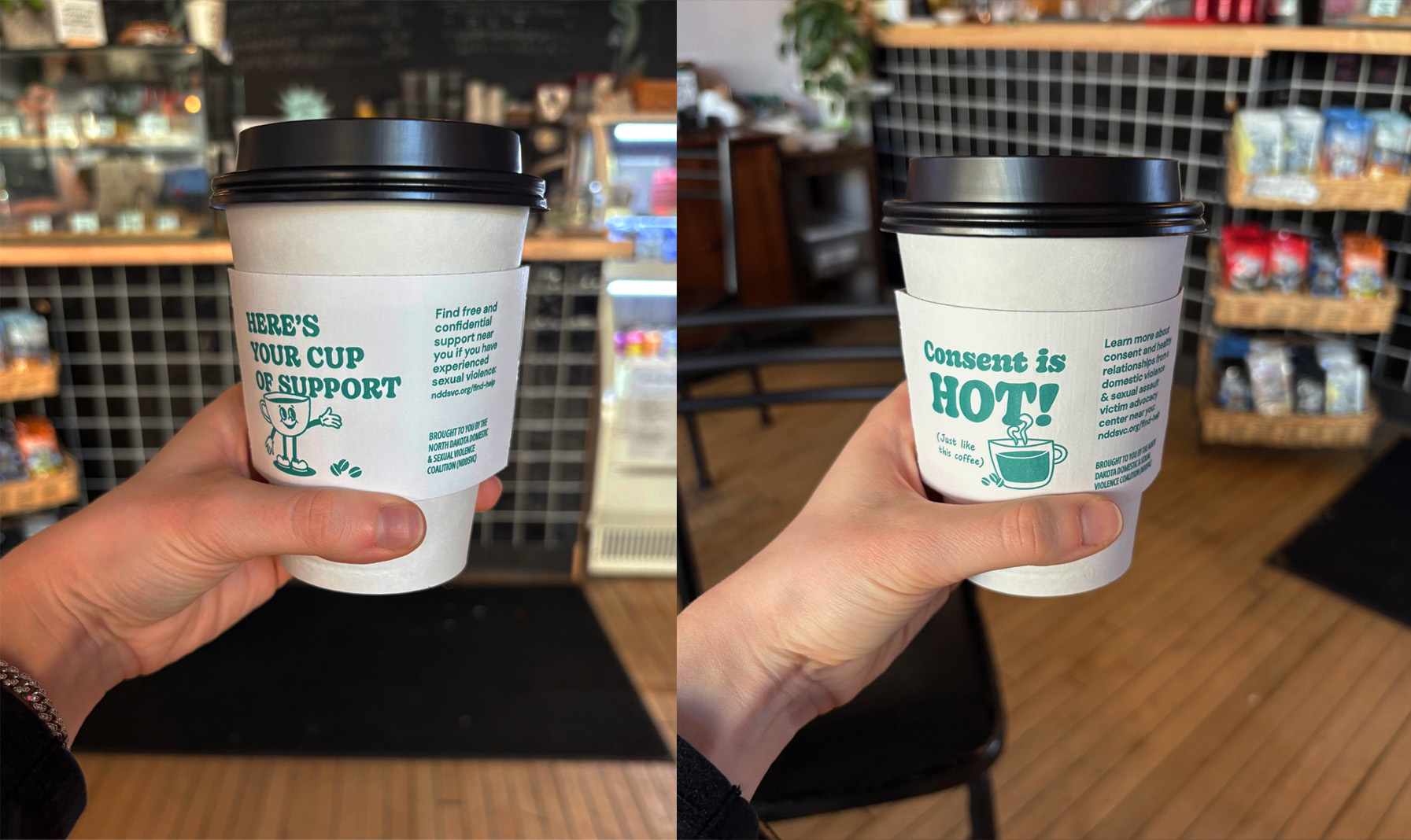
BISMARCK, ND —During April, the North Dakota Domestic & Sexual Violence Coalition (NDDSVC) is sharing cups of coffee that carry an important message. As a part of their Sexual Assault Awareness Month (SAAM) campaign, NDDSVC created custom coffee sleeves that have information on consent and supportive services for survivors of sexual violence. The coalition distributed the coffee sleeves to its member organizations—19 domestic violence and sexual assault victim advocacy centers across the state—who are then partnering with coffee sellers to share the coffee sleeves in North Dakota communities.
One coffee sleeve reads “Here’s your cup of support” beside a friendly looking coffee cup character. A URL on the coffee sleeve leads to an online directory of NDDSVC’s member organizations. Each organization provides free and confidential support to victims of sexual assault, including helping victims access medical care, mental health support and legal support, if desired.
Another coffee sleeve reads, “Consent is HOT! (Just like this coffee)” The URL on the coffee sleeve leads to the same advocacy center directory, where individuals can contact their local organization to learn more about consent and healthy relationships.
“Just like your morning latte might help you get through the day, we want survivors to know that advocates can help them get through the trauma that can come with experiencing sexual assault,” said Seth O’Neill, Executive Director of NDDSVC.
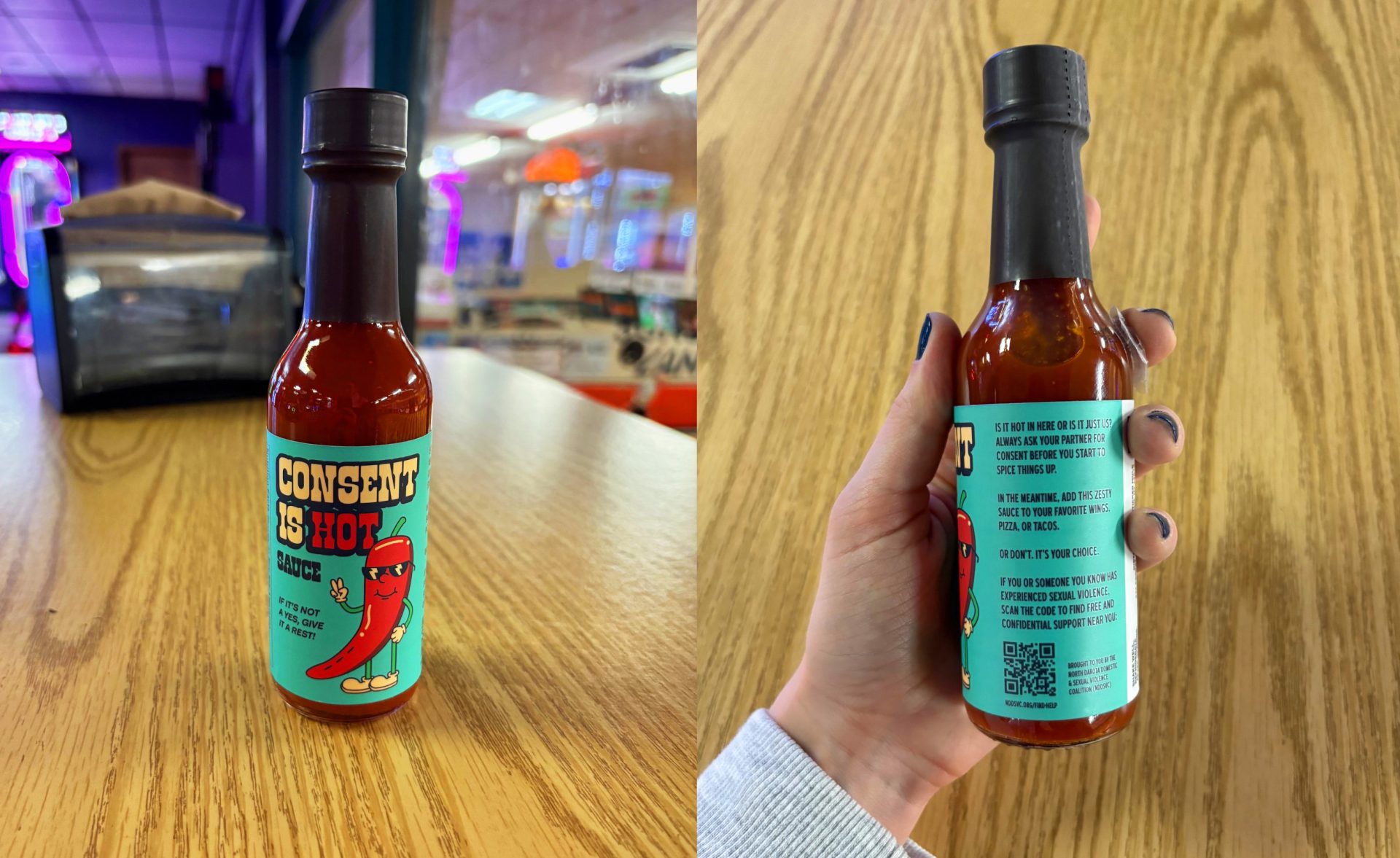
In addition to the coffee sleeves, NDDSVC also created custom bottles of hot sauce that read “Consent is Hot” and “If it’s not a yes, give it a rest!”
“Our hope is that the hot sauce creates conversations about consent and why it’s so important,” said Amie Britz, Communications Coordinator at NDDSVC. “Without consent, sexual activity becomes sexual violence. I think a lot of people understand that consent is essential, but we want to go beyond that and make consent something that is celebrated and championed by the people of North Dakota.”
Like the coffee sleeves, the hot sauce bottles have information to connect victims and survivors of sexual violence with supportive services. A QR code on the label leads to the online directory of NDDSVC’s member organizations.
If you or someone you know has experienced sexual assault, abuse or harassment, free and confidential support is available 24/7 in North Dakota. Visit nddsvc.org/find-help to find help near you.
###
The North Dakota Domestic & Sexual Violence Coalition (NDDSVC) supports and serves as a unified voice for 19 domestic violence/sexual assault (DV/SA) victim advocacy centers across North Dakota. From training and educational materials to public awareness and legislative policy change, NDDSVC works to provide North Dakota communities with the best tools and information to better support victims and survivors of domestic and sexual violence.
NDDSVC leads statewide campaign to raise awareness of sexual assault
Each year, survivors, advocates and community supporters recognize Sexual Assault Awareness Month (SAAM) in April. As the leader against sexual violence in North Dakota, the North Dakota Domestic & Sexual Violence Coalition (NDDSVC) is coordinating a statewide campaign for Sexual Assault Awareness Month. All month long, the coalition will be sharing information on consent and how to get help if you’ve experienced sexual violence. NDDSVC is also collaborating with their 19 member organizations to share coffee sleeves and hot sauce with consent-centered messages in North Dakota communities.
NDDSVC’s member organizations are also hosting events and sharing content on their social media channels to raise awareness and inform North Dakotans on the prevalence of sexual assault in our communities.
For victims and survivors of sexual violence, free and confidential help is available 24/7 in North Dakota. Go to nddsvc.org/find-help to find support near you.
###
The North Dakota Domestic & Sexual Violence Coalition (NDDSVC) supports and serves as a unified voice for 19 domestic violence/sexual assault (DV/SA) victim advocacy centers across North Dakota. From training and educational materials to public awareness and legislative policy change, NDDSVC works to provide North Dakota communities with the best tools and information to better support victims and survivors of domestic and sexual violence.
North Dakota Domestic & Sexual Violence Coalition Statement on Ray Holmberg’s Decades of Abuse and Exploitation
The news of Ray Holmberg’s abuse and exploitation of men and boys over the course of several decades is deeply disturbing and concerning. The North Dakota Domestic & Sexual Violence Coalition (NDDSVC) strongly condemns these terrible acts of sexual violence and exploitation, along with all other forms of sexual assault, abuse, and harassment.
At NDDSVC, victims and survivors of domestic and sexual violence have always been, and always will be, at the forefront of our work. Our thoughts are with the victims of Ray Holmberg and their families. We hope that Holmberg’s sentencing brings some sense of justice and peace.
We also hope that the names of the individuals who enabled his abuse are brought to light.
Certain individuals close to Holmberg were aware of his continuous abuse of men and boys in North Dakota, across the U.S., and abroad. Investigators have found emails and messages between Holmberg and his former colleagues and friends where he admits to abusing men and boys. Whether those who knew stayed silent out of fear, negligence, or for their own personal gain, we owe it to victims and survivors to bring those individuals to justice as well. Holmberg himself is ultimately the one to blame for his crimes, but we must also address how his abuse and exploitation of others was able to continue for so long.
Sexual violence thrives in a culture of isolation and silence, and Ray Holmberg used power and control to keep those around him silent. We cannot let others like him do the same. We call on North Dakotans to turn your anger, sadness, or outrage around this case into action.
If you are concerned that a friend, family member, coworker, or neighbor may be experiencing abuse or exploitation, reach out to them. Let them know they’re not alone and that you’re there for them. Ending the culture of isolation and silence begins with reaching out a helping hand.
If you see warning signs that someone may be abusing or exploiting others, say something. Depending upon your situation, you can report to your school, workplace, or to law enforcement. Anonymous tips can be reported to law enforcement officials through ND Tip.
We believe in a North Dakota without sexual violence, but it will take everyone, especially those in positions of power, to get there. Lawmakers, law enforcement officials, community leaders, and individuals across the state must speak out against sexual violence and prioritize the safety and well-being of all North Dakotans, especially those who are most at risk of exploitation and abuse.
In solidarity,
NDDSVC
If you’ve experienced sexual violence, know that what happened to you was not your fault. You can find free and confidential support at any of the 18 domestic violence and sexual assault victim advocacy centers in North Dakota. Each center is staffed with professionals that can help you navigate your options and stay safe. Go to our Find Help pageto view a directory of domestic and sexual violence victim advocacy centers and find support near you.
To find more ways to join the movement against domestic and sexual violence, view our Get Involved page.
Join NDDSVC and our members on February 14th as we connect with legislators at our Advocacy Day at the Capitol!
The coalition and some of our member organizations will be setting up booths in Memorial Hall to provide information on domestic violence and sexual assault victim services in North Dakota. Come visit to learn more about what we do and how we’re advocating for survivors this session.
We will also be facilitating the In Her Shoes activity, an interactive simulation that walks you through the experiences of a victim of domestic violence. Participants are given a card describing the background and current situation of a victim/survivor and then make choices about their character’s next steps. The activity takes about 15 minutes to complete and can help you understand the complex dynamics and challenges that victims in North Dakota face.
The Silent Witness Exhibit,a display made up of red silhouettes that honor women and children who were murdered in acts of domestic violence will be available for viewing.The Clothesline Project, an exhibit of shirts made by victims and survivors in North Dakota, will also be on display.
We hope to see you there!
The details
Who: North Dakota Domestic & Sexual Violence Coalition, domestic and sexual violence victim service providers, legislators, members of the public are welcome
What: NDDSVC Advocacy Day at the Capitol
When: Friday, February 14, 2025, 8:00am-1:00pm
Where: Memorial Hall North Dakota State Capitol Building 600 East Boulevard Avenue Bismarck, ND 58505
Donate Now
Thousands of North Dakotans experience domestic and sexual violence each year. But together, we can change that. By giving to NDDSVC, you’re helping us prevent future violence and providing life-saving resources to North Dakota communities.
If you are in an unsafe or abusive situation, there are 18 domestic violence/sexual assault (DV/SA) victim advocacy centers across North Dakota that can help you navigate your options and stay safe. Each center is staffed with professionals who can help you with safety planning, finding shelter, obtaining a protection order, and more.





 Stay Connected
