Safety Alert: If you are in danger, use a safe or private computer that an abuser does not have direct or remote access to. Learn more about technology safety at techsafety.org. NDDSVC does not provide direct services to victims and survivors. Contact a DV/SA advocacy center near you to get help. If you are in immediate danger, call 911.
NDDSVC releases 2025 data on domestic and sexual violence
BISMARCK, N.D. — Each year, the North Dakota Domestic & Sexual Violence Coalition (NDDSVC) compiles data from domestic violence and sexual assault victim advocacy centers across the state to put together annual fact sheets. The fact sheets give a snapshot of how many victims of domestic violence and sexual assault are reaching out for help and what kinds of violence they are facing.
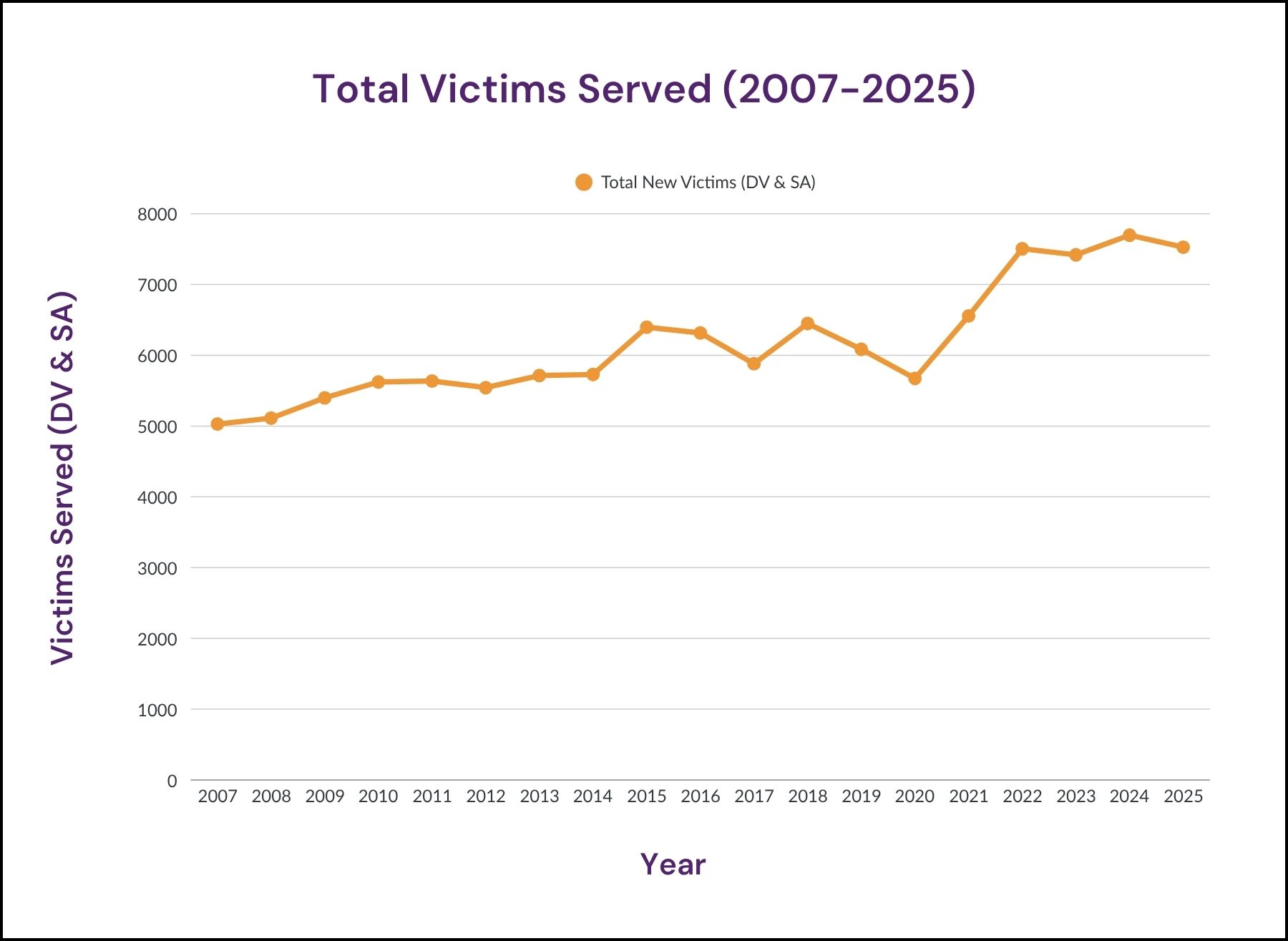
The latest fact sheets show that 6,218 victims of domestic violence and 1,309 victims of sexual assault were served by advocacy centers in 2025, a 1.8% and 3.9% decrease from 2024 respectively.
NDDSVC says that domestic violence can happen to anyone, but women and children are most commonly victimized. Of the domestic violence victims served in 2025, 81% were women. At least 150 women were pregnant at the time they were assaulted, and 4,640 children were directly impacted by domestic violence incidents.
Women and children are also most commonly victimized in sexual assault cases. At least 934 of the 1,309 sexual assault victims served in 2025 were women, and at least 188 primary victims were under the age of 18 at the time of the assault(s).
People with disabilities in North Dakota were also highly impacted. In 2025, 24% of new domestic violence victims served were people with disabilities. Of the sexual assault victims served, more than a quarter (28%) were people with disabilities.
While their annual data gives insight into how many people are reaching out for help, NDDSVC says that it doesn’t represent the full scope of how many North Dakotans are experiencing domestic and sexual violence. The 7,527 victims served in 2025 are only a fraction of the people experiencing violence they say, as many cases go unreported, not every victim reaches out for support, and some victims may get help from sources outside of NDDSVC’s 18 member organizations. The coalition says that funding to continue services is essential to reaching more victims and survivors.
“Since the COVID-19 pandemic, we’ve seen a dramatic increase in the need for domestic and sexual violence services,” said Seth O’Neill, NDDSVC’s Executive Director. “Our members have stepped up to meet that need, and we’re grateful to the state legislature for providing the additional funding that allows them to do so.”
NDDSVC says advocacy centers work tirelessly to provide essential, life-saving services every single day. Advocacy centers served 344 victims of domestic violence in just one day in 2025, according to the National Network to End Domestic Violence (NNEDV) 20th Annual Domestic Violence Counts Report. NDDSVC’s annual fact sheets state that at least 22,175 services were provided by advocates to victims of sexual assault from January to December 2025, and domestic violence advocates provided victim assistance with 508 emergency protection orders throughout the year.
The North Dakota Domestic & Sexual Violence Coalition (NDDSVC) supports and serves as a unified voice for 18 domestic violence/sexual assault (DV/SA) victim advocacy centers across North Dakota. From training and educational materials to public awareness and legislative policy change, NDDSVC works to provide North Dakota communities with the best tools and information to better support victims and survivors of domestic and sexual violence.
We read news stories about sexual violence happening in North Dakota every week.
Statistically speaking, young adults in college face the greatest risk of experiencing sexual violence. Across the United States, 13% of all college students experience rape or sexual assault. And when you break that number down, the rates are even more alarming for specific groups. More than one in four undergraduate women (26.4%) experience sexual assault during their college years, and 21% of students with nonconforming gender identities face similar violence.
According to the Rape, Abuse & Incest National Network (RAINN), women ages 18-24 who are college students are three times more likely than women overall to experience sexual violence. Male college students in the same age range are 78% more likely than their non-student peers to be victims of rape or sexual assault. RAINN also notes that sexual violence occurs more often on campuses than some crimes that receive far more public attention. Female college students are two times more likely to be sexually assaulted than robbed.
What is it about campus environments that causes more sexual violence?
For many young people, college represents independence, opportunity, and the beginning of adulthood. But unfortunately, these exact aspects of campus life increase the risk of sexual violence. College is the first time many students are living away from home. Students may be in an unfamiliar environment, without the family, teachers, coaches, and community members that once surrounded them. New social circles, party culture, and alcohol consumption also play a role. Many students are navigating these experiences for the first time, sometimes without clear guidance or boundaries, and what was once an exciting environment full of possibilities can quickly become one associated with pain and trauma.
But focusing only on the campus environment misses the deeper issue.
Sexual violence isn’t about sex. It’s about power and control. It grows from attitudes and beliefs about who holds power in our society and who does not. Sexism, racism, homophobia, and ableism can create harmful ideas about who is valued in our society and who is not. These beliefs are often normalized in entertainment media and everyday conversation through objectification or degrading stereotypes. And while most people who repeat a sexist or homophobic joke or stereotype will never commit sexual violence, these harmful attitudes create a culture where disrespect, entitlement, and dehumanization are tolerated. When those beliefs escalate, they can lead to harassment, coercion, and eventually, sexual assault.
To prevent sexual violence, both on and off college campuses, we must focus on preventing perpetration. We must address harmful attitudes and beliefs before they can ever escalate to violence.
Across North Dakota, many campuses provide Title IX resources, survivor advocacy services, prevention education, and bystander intervention training. Campus orientation sessions often include discussions about consent, alcohol safety, and reporting options.
These steps matter, but true prevention requires a broader community effort.
Students can support each other by promoting consent and speaking up when they see harmful behavior. Bystander intervention—stepping in when someone may be at risk—can stop situations before they escalate.
Parents and caregivers should have open conversations about respect, relationships, boundaries, and consent long before their children leave for college. These discussions help students recognize unhealthy behaviors and understand the importance of accountability.
Colleges must continue investing in prevention education and supportive services for survivors. And most importantly, they must take reports of sexual violence seriously and hold perpetrators accountable. Without the support of their college, victims are left to navigate a traumatic experience alone, and perpetrators face no consequences for their crimes.
And finally, everyone must challenge the attitudes and beliefs that allow sexual violence to exist in the first place. Young people should not have to avoid meeting new people, spending time on campus, or consuming alcohol to avoid being sexually assaulted. Preventing sexual violence means building environments where respect, consent, and equality are the standard, and where abusive behavior is neither normalized nor ignored.
A Needs Assessment on ND’s Response to Survivors of Domestic Violence with Co-Occurring Behavioral Health Issues
The North Dakota Domestic and Sexual Violence Coalition (NDDSVC) commissioned a Family Violence Prevention and Services Act (FVPSA) Grant Needs Assessment Annual Update project to examine how survivors of domestic violence with co-occurring behavioral health issues are supported across North Dakota. Survivors and advocates alike reported that the prevalence and severity of these intersecting issues are increasing, yet the state’s current service and response systems remain insufficient to meet the complexity of survivors’ needs. The project sought to document survivors’ lived experiences, identify strengths and gaps in service delivery, and develop recommendations for strengthening responses at the individual, community, and systems levels.
Over a ten-month period, this Needs Assessment project engaged thirty survivors across the state as well as advocates from over 80% of North Dakota’s domestic violence advocacy programs, behavioral health and treatment providers, and a multidisciplinary group of responders. Survivors described experiencing profound forms of abusive coercive control tactics, isolation, and repeated abuse often compounded by substance use as a coping strategy, untreated complex trauma, and abuser-driven behavioral health manipulation. Nearly all participants reported significant mental health complications, more than half disclosed substance abuse challenges, and more than one-quarter reported a diagnosed mental illness. Advocates in every region of North Dakota confirmed that survivors presenting with these complex needs represent a substantial and growing portion of their caseload.
View the report’s findings and recommended actions by clicking the button below.
NDDSVC is now accepting applications for our Women’s Opportunity Scholarship!
The Women’s Opportunity Scholarship Fund provides higher education opportunities to low-income women who wish to enter, or are currently attending, a North Dakota college, university, or trade school. The fund helps scholarship recipients break the bonds of poverty and enhance their lives and the lives of their families intellectually, culturally, and environmentally.
NDDSVC leads statewide campaign to raise awareness of sexual assault
Each year, survivors, advocates and community supporters recognize Sexual Assault Awareness Month (SAAM) in April. As the leader against sexual violence in North Dakota, the North Dakota Domestic & Sexual Violence Coalition (NDDSVC) is coordinating a statewide campaign for Sexual Assault Awareness Month. All month long, the coalition will be sharing information on consent and how to get help if you’ve experienced sexual violence. NDDSVC is also collaborating with their 18 member organizations to share “Consent is Key” key chains and awareness stickers throughout April.
NDDSVC’s annual statistics on sexual assault in North Dakota show that in 2024 alone, 1,363 victims of sexual assault were served by advocacy centers across the state. At least 1,101 of the victims were female, and at least 782 assailants were male. Over 20,000 services were provided to sexual assault victims by advocacy center advocates from January to December 2024.
NDDSVC’s member organizations are also hosting events and sharing content on their social media channels to raise awareness and inform North Dakotans on the prevalence of sexual assault in our communities.
For victims and survivors of sexual violence, free and confidential help is available 24/7 in North Dakota. Go to nddsvc.org/find-help to find support near you.
###
The North Dakota Domestic & Sexual Violence Coalition (NDDSVC) supports and serves as a unified voice for 19 domestic violence/sexual assault (DV/SA) victim advocacy centers across North Dakota. From training and educational materials to public awareness and legislative policy change, NDDSVC works to provide North Dakota communities with the best tools and information to better support victims and survivors of domestic and sexual violence.
North Dakota Domestic Violence Counts Report
BISMARCK, ND – According to the National Network to End Domestic Violence (NNEDV)’s 20th Annual Domestic Violence Counts Report, on September 10, 2025, 17 domestic violence programs across North Dakota:
Served 344 adult and child victims of domestic violence,
Received 129 hotline contacts, and
Provided 7 educational sessions and trainings to 213 members of the public.
On that same day, 52 requests for services went unmet due to a lack of resources, funding, and/or staffing. About 21% of these unmet requests were for emergency shelter, hotels, motels, transitional housing, and other housing.
Conducted annually by the National Network to End Domestic Violence (NNEDV) since 2006, the Domestic Violence Counts Survey is a one-day, unduplicated count of adults and children seeking domestic violence services in the United States. Each year, the Domestic Violence Counts Report summarizes this data and shares stories of both hope and heartbreak—from advocates connecting survivors and their children with lifesaving assistance, to programs being forced to turn away victims who urgently need help.
The North Dakota Domestic & Sexual Violence Coalition (NDDSVC) joined the National Network to End Domestic Violence (NNEDV) in launching the 20th Annual Domestic Violence Counts Report this year. For twenty years, Domestic Violence Counts has been the premier trusted source of data on the services domestic violence advocates provide to survivors every day.
“The Domestic Violence Counts Report has data to support what we already knew: Advocates work tirelessly to help survivors stay safe and heal, and the need for services has never been greater,” Seth O’Neill, NDDSVC’s Executive Director, said. “With 344 survivors served in a single day, and 52 unmet requests for services, funding for the Violence Against Women Act (VAWA), Family Violence Prevention and Services Act (FVPSA), and Victims of Crime Act (VOCA) grants are essential for programs, advocates, and survivors.”
On a national level, the latest Domestic Violence Counts Report found that participating programs across the country:
Served 84,146 adults and children with critical services and support,
Received 23,747 hotline contacts, sharing essential information and resources, and
Educated 18,843 people, helping raise awareness of domestic violence in their communities.
Tragically, 13,018 requests for services went unmet because programs lacked sufficient resources.
Additional resources must be provided, system-wide responses must be improved, and barriers to safety and justice must be eliminated to ensure that survivors are not left without resources and that no program is ever forced to turn away survivors or close their doors when faced with a decrease in funding.
The North Dakota Domestic & Sexual Violence Coalition (NDDSVC) supports and serves as a unified voice for 18 domestic violence/sexual assault (DV/SA) victim advocacy centers across North Dakota. From training and educational materials to public awareness and legislative policy change, NDDSVC works to provide North Dakota communities with the best tools and information to better support victims and survivors of domestic and sexual violence.
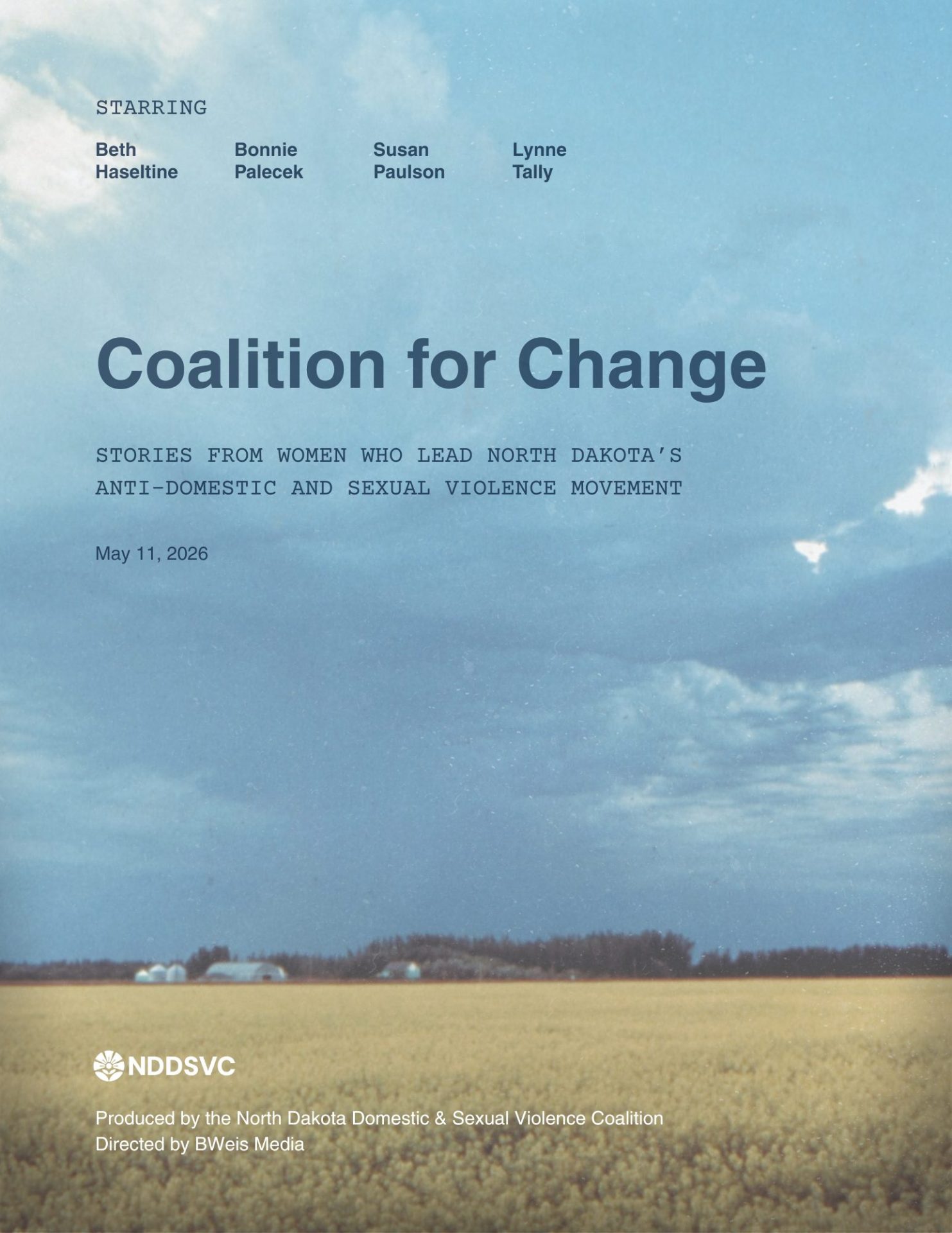
Join Us for the Premiere of Our New Documentary: Coalition for Change
What makes a movement?
We sat down with four pioneers of North Dakota’s anti-domestic and sexual violence movement to answer the question.
Featuring NDDSVC’s founding Executive Director, Bonnie Palecek, and other leaders of the movement, Coalition for Change is a reflection on our grassroots origins and where we are today. The 30-minute short film is both a historical record and a means of passing the work along to a new generation of leaders.
Former leaders share stories of pure joy, sheer will, devastating heartbreak, and the everyday helpers who stepped up to support survivors when it mattered most. Join us as we celebrate the strength and perseverance of women who did not see themselves as revolutionaries, but described themselves simply as “women helping women.”
On the big screen for one night only, you won’t want to miss this inspiring event. Seats are limited, so secure your tickets today!
Details
Date: May 11, 2026
Time: 7:00pm-8:00pm (Doors open at 6:30pm, show starts at 7:00pm)
Location: Dakota Stage, 412 E Main Ave, Bismarck, ND 58501
When we hear about someone in an abusive relationship, the first question many people ask is, “Why don’t they just leave?”
But leaving an abusive relationship is not a simple decision. For many victims, it’s not “just leaving.” It’s a terrifying balance of actions and consequences. Behind every delay or hesitation is a web of fear, uncertainty, and survival strategy:
What if no one even believes my partner was abusive? How will I afford rent, food, childcare, and other expenses on my own? If I leave, will I lose my friends, my family, my community? Where would I even go if I left? If I do go, what will my partner do if they find me? What if they try to kill me when I leave? What if they hurt my children to get to me?
What if, what if, what if.
It begs the question, is the chance of a better life worth walking across a field of landmines, where every step could bring even more danger?
In victim services work, instead of asking victims to brave the field alone, we ask how we can build a bridge over it. In other words, instead of asking, “Why do they stay in that relationship?” we ask, “What do they need to leave?” And while every situation is different, there are some common factors that can help a person escape an abusive relationship:
Support from family members, friends, and neighbors
Available space at a domestic violence shelter or other safe shelter
Police, prosecutors, and judges who believe them
Understanding and support from doctors, psychologists, faith leaders, social service workers, and teachers
Access to advocates who can help with obtaining protection orders, mental health support, and safe shelter
Access to money, bank accounts, and/or financial information to support themselves and their family without the abuser’s contributions
And perhaps most importantly, institutional enforcement that ensures the abuser will leave them alone after they leave, like enforcing protection orders and criminal laws.
If someone you know is experiencing domestic violence, you may not be a law enforcement officer that can help enforce their protection order. You may not be a victim advocate that’s trained in providing trauma-informed emotional support. You may not be a medical provider that can treat their injuries.
But you can be someone they can lean on when they’re ready to leave.
In honor of Domestic Violence Awareness Month this October, we encourage everyone to be like that support person. Be the person that holds a go-bag for a friend. Be the family member that keeps copies of their important documents. Be the acquaintance that gives them a safe place to stay while they plan for what’s next.
Because when you fall down, a strong safety net makes all the difference.
If you or someone you know has experienced domestic or sexual violence, free and confidential help is available 24/7. Visit the North Dakota Domestic & Sexual Violence Coalition (NDDSVC) website to find a domestic and sexual violence advocacy center near you.
BISMARCK, ND—This fall, the North Dakota Domestic & Sexual Violence Coalition (NDDSVC) is spreading the message “Every1KnowsSome1” to highlight how common domestic violence is across the state. They say that more than 1 in 4 women and 1 in 10 men will experience sexual violence, physical violence and/or stalking by an intimate partner in their lifetime (CDC). In 2024 alone, 6,334 new victims of domestic violence were served by 17 domestic violence victim advocacy centers across North Dakota.
October is Domestic Violence Awareness Month (DVAM), and as the leader against domestic violence in North Dakota, NDDSVC coordinates a statewide campaign to help North Dakota communities identify and eliminate domestic violence. All month long, the coalition will be sharing information on domestic violence and how to support survivors. The coalition is also collaborating with their member organizations—18 domestic violence and sexual assault victim advocacy centers across the state—to share their own custom-made air fresheners that promote “A Fresh Start,” a nod to what many victims are looking for when they contact an advocacy center.
“Everyone knows someone who has experienced domestic violence, whether it’s a friend, family member, coworker, or neighbor,” said Seth O’Neill, Executive Director of NDDSVC. “Domestic Violence Awareness Month gives us the opportunity to not only celebrate the strength of the survivors in our lives, but to also have important conversations about domestic violence so that we can prevent this deadly crime from happening in the future.”
NDDSVC encourages community members to support survivors and call out harmful attitudes and beliefs that can lead to violent actions. They say that domestic violence affects all of us, so all of us must be part of the solution to end it.
For victims and survivors of domestic violence, free and confidential help is available 24/7 in North Dakota. Go to nddsvc.org/find-help to find support near you.
###
The North Dakota Domestic & Sexual Violence Coalition (NDDSVC) supports and serves as a unified voice for 18 domestic violence/sexual assault (DV/SA) victim advocacy centers across North Dakota. From training and educational materials to public awareness and legislative policy change, NDDSVC works to provide North Dakota communities with the best tools and information to better support victims and survivors of domestic and sexual violence.
Empowering women through education: NDDSVC awards $13,500 in scholarships
BISMARCK, ND—In August, the North Dakota Domestic & Sexual Violence Coalition (NDDSVC) awarded a total of $13,500 to seven women through the organization’s Women’s Opportunity Scholarship.
The Women’s Opportunity Scholarship provides financial assistance to low-income women pursuing higher education in North Dakota. The scholarship aims to break the bonds of poverty and empower women to enhance their lives and the lives of their families both economically and intellectually. Scholarship funds help recipients pay for tuition, books and other school expenses.
Mina Afrasiabi, Grand Forks—University of North Dakota
Nicelette Blowers, Bismarck—Minot State University
Jenna Brave Bull, Mandan—Bismarck State College
Jennifer Grohs, West Fargo—North Dakota State University
Jaylee Jay, Minot—Minot State University
Damaris Ortega Rivera, Mandan—Bismarck State College
Lataya Seminole, Bismarck—United Tribes Technical College
“These recipients have shown strength when faced with adversity and have big goals for the future,” said Dana Mees, Assistant Director at NDDSVC. “It’s an honor to support them through the Women’s Opportunity Scholarship and be part of their journey.”
The North Dakota Domestic & Sexual Violence Coalition (NDDSVC) supports and serves as a unified voice for 18 domestic violence/sexual assault (DV/SA) victim advocacy centers across North Dakota. From training and educational materials to public awareness and legislative policy change, NDDSVC works to provide North Dakota communities with the best tools and information to better support victims and survivors of domestic and sexual violence.
Donate Now
Thousands of North Dakotans experience domestic and sexual violence each year. But together, we can change that. By giving to NDDSVC, you’re helping us prevent future violence and providing life-saving resources to North Dakota communities.
If you are in an unsafe or abusive situation, there are 18 domestic violence/sexual assault (DV/SA) victim advocacy centers across North Dakota that can help you navigate your options and stay safe. Each center is staffed with professionals who can help you with safety planning, finding shelter, obtaining a protection order, and more.






 Stay Connected
